Showing posts with label Europe. Show all posts

Tuesday, March 19, 2013

Pope Francis I Begets Family Memories - Part II


My previous blog was about Mother.  This one is about my Uncle Pierre, Catholic priest, who inspired Mother to choose her religious vocation.

 Uncle Pierre was my Mother’s cousin.  His family was the one Mother grew up with when my grandmother died in childbirth.  His Parish, St. Martens-Voeren in Belgium is bordered by both Holland and Germany.  The primary language is Dutch, German is secondary.  (see picture of the presbytery [define: the home of Roman Catholic parish priest])

I spent part of my summers (see blog dated 10/4/12, Summers spent in a Dutch windmill) at the Parish campgrounds in St. Martens-Voeren.  I was a Belgian (what Americans would call) Girl Scout.  We would spend the month of July having the time of our lives.  It was special one-on-one time to spend with my Uncle.

During World War II, he was imprisoned for 2 years in a concentration camp in Dachau, Germany.  The memory of what he had undergone never left him. Every decade, starting in 1950, he and the other surviving priests returned to Dachau, each celebrated Mass for those who died at the camp. (Over 1000 priests died in Dachau.)

In 1970, he stopped in Frankfurt for a short visit with my husband and me.  I remember as soon as he stepped from the train, he was shivering, scared.  He disclosed the terror would return every time he was in Germany,  The fear left as soon as the train crossed the border back into Belgium. At the time of his visit, there were only 30 priests left to perform the mass at the camp.  He seemed relieved he would not have to stay long. 

Uncle Pierre was the parish Priest in Ruanda for over 30 years.  Ruanda was a Belgian colony until 1961.  Catholicism is the primary religion in Ruanda.  Uncle Pierre loved Africa and “his” Rwandan people.  (see picture of Uncle Pierre and his parishioners during one of the Rwandan celebrations)


He encouraged my cousin, Joseph, to come to Ruanda when Josef took his final vows as a priest.  When my uncle retired, (Father) Joseph continued working and teaching in Ruanda. (translation of picture from French to English:  Joseph Schmetz, Priest for the Church of Rwanda, Nyundo)

Uncle Pierre was instrumental in reducing the deaths of Rwandans in his parish from HIV aids by actively discussing and promoting the use of condoms.  He shared with me, the deaths he saw daily amongst women, men, but most of all, babies prompted him to make the decision he made counter to the Vatican’s doctrine.  He felt God would approve of his decision and he could live with that.

I lived in Belgium from 1988 to 1996.  My girlfriend’s husband was a doctor with Médecins Sans Frontier (Doctors without Borders).  During Ruanda’s 100-day genocide in 1995, it was my connection to my Uncle and Ruanda that prompted me to participate in transporting medicines, clothes, and other necessities from Antwerp to Ruanda.  My professional role at the time was Materials Manager Europe for a global automotive seat manufacturer.  I used those connections to schedule the trucks, define the logistics, and the documentation needed to cross borders throughout Europe and Africa.  Médecins Sans Frontier is the only organization I make sure I donate to each year.  They truly represent the best-in-class of the medical profession.
 
I saw Uncle Pierre frequently once he retired. He loved to talk about his church and his people and I loved listening to, and learning from, him.  The picture of the two of us walking the countryside in Eupen, Belgium is the last time I saw him before he passed away.

Yes, the selection of Pope Francis I makes me think of my Mother and my Uncle and the memories flood over me.


Monday, March 18, 2013

Pope Francis I Floods Family Memories


White smoke billowing from the Sistine Chapel.   The selection of a new Pope floods my memories with thoughts of my Mother. I keep the four visual memories of Mother’s first marriage - to God - in a shadowbox (see picture). 


My Mother was born in the Netherlands in 1916.  She was the third child born to my maternal grandparents.  She lost her mother, my grandmother, at the age of 4.  My grandmother died in 1920 during the birth of her fourth daughter.  My grandfather could not support the 4 children he had and they were separated throughout the family.  My mother lived with relatives in Belgium. 

She entered the convent as a Postulant at the age of 20.  A Postulant is the name given to a young girl or woman their first year.  It is year of “internship”.  It helps them decide whether this is the life that is right for them.  It gives the postulant the opportunity to live the religious life through personal experience.  It also gives the convent nuns the opportunity to help the Postulants with their decision-making.  A year later, in 1937, sure this was her vocation in life she made the decision of free consent and started her first year as a Novice (a person formally admitted to a religious institute to prepare for eventual religious profession.).


During the ceremony, one of joy and pride, she received her black habit  and white veil.  Nuns have their hair cut during this initiation.  At that time, nuns had to cut their long hair to symbolize relinquishing any vanity they possessed. (see picture of mother’s beautiful long braid)   Today, nuns are free to keep their long hair. They pass through a novitiate (probationary period) of two years.


The third year, 1940, she took her First vows (today also called Temporary vows or Temporary Professed vows).  At that time, her black veil replaced the white one worn during the novitiate period.  (see picture of Mother).  First vows are for five years at which time one takes the Permanent vows (also, Perpetually Professed or Final Profession) as a nun.  She taught kindergarten.  I believe my love for children and teaching comes from my Mother. 


The war broke out in Europe in 1940.  Initially, the one place the Jews fled to, from the Nazis, was the Catholic convents.  When the Nazis finally arrived, they not only captured the Jews but the Nuns too.

My mother spent 2 years in a concentration camp.  The stories she shared with us were filled with horror. The Nazis made them run naked (what greater humiliation for a nun?) through the camp to get their one bowl of soup.  They would then have to run back spilling most of the soup on their return.  The Nazis tortured the nuns as well as the Jews.  The removal of the bone in my Mother’s left-hand wrist proved a constant reminder until the day she passed away.

The first US military soldiers to land in Europe were the Negro units.  Many Europeans, like my Mother's family, will tell you, they did not know there were white Americans until later in the war.  My father's battalion (see previous blog “Remembering a Negro WWII Battalion”) was one of the first to liberate people from the concentration camps.  One of those was my Mother. 

The first night they took refuge in underground bunkers.  A bomb hit the bunker my Father, my Mother and others were in.  My Father's back was broken by the explosion.  The only place one could take American soldiers was the Catholic convent.  My Mother spoke English (actually she spoke 8 languages) and became the translator between my Father and his doctors.  During his recuperation, my parents fell in love.  My Mother said “yes” to my father’s marriage proposal.  She shared her decision to leave her first “marriage” with Mother Superior and left the convent 6 months before she was to take her final vows.

The Sisters gave Mother her missal to keep as a souvenir (see picture).  The rosary in the shadowbox is one Mother had blessed in Rome by Pope Pius XII.  The back of the crucifix lists Rome, Italy.


My parents were married 52 years.


Thursday, October 4, 2012

Summers Spent in a Dutch Windmill


I grew up in France.  My father was an American soldier in the U. S. army; my mother, born in Holland and a former professor of art and music at the Sorbonne in Paris.  We lived in Metz, France, a part of the (western) Strasbourg region.  For my yearly summer vacations my parents would drive the 4 hours to my aunt’s (mom's sister) house, in Bemelen, Holland. They would spend several hours reuniting with family and would drive back home to Metz in the evening.


My aunt and uncle owned a dairy farm.  They also had chickens and pigs.  The best part of the farm was a (real Dutch) windmill that stored the food for the animals.  It was always fun during the day to go inside and play.  I would spend the day with my uncle and older cousins driving the tractor, feeding the animals, and waiting for my cousins to come back from school (the French and Dutch kids only have one month vacation, we Americans have 3).   At the end of the summer, my parents would pick me up and I would be back in Metz just in time for school to start.  The American and French kids always thought I was so lucky and I did too.

One summer I arrived and the windmill had been remodeled from a storage place for animal food to a 2-story apartment!  I was too young to sleep there by myself at night but during the day I would go in the living room to nap, read books or write letters to my parents back in Metz. (This was the 1960’s – we had no cell phones or internet.  Telephones were only used for local calls. Long distance calls were very expensive.)  My father was transferred to the US in 1964.  I missed those vacations in Holland with my family.
  
In 1970 my husband, also a soldier in the US Army, was transferred to Germany.  My mother came to visit and we drove up to Bemelen for the day to reunite with the family.  My son was born in Frankfurt.  When we returned to the US in 1975 he was 2 years old so it was not a place he remembered. On his 16th birthday, I took him back to Europe. We visited family and friends in France and then headed to Bemelen.

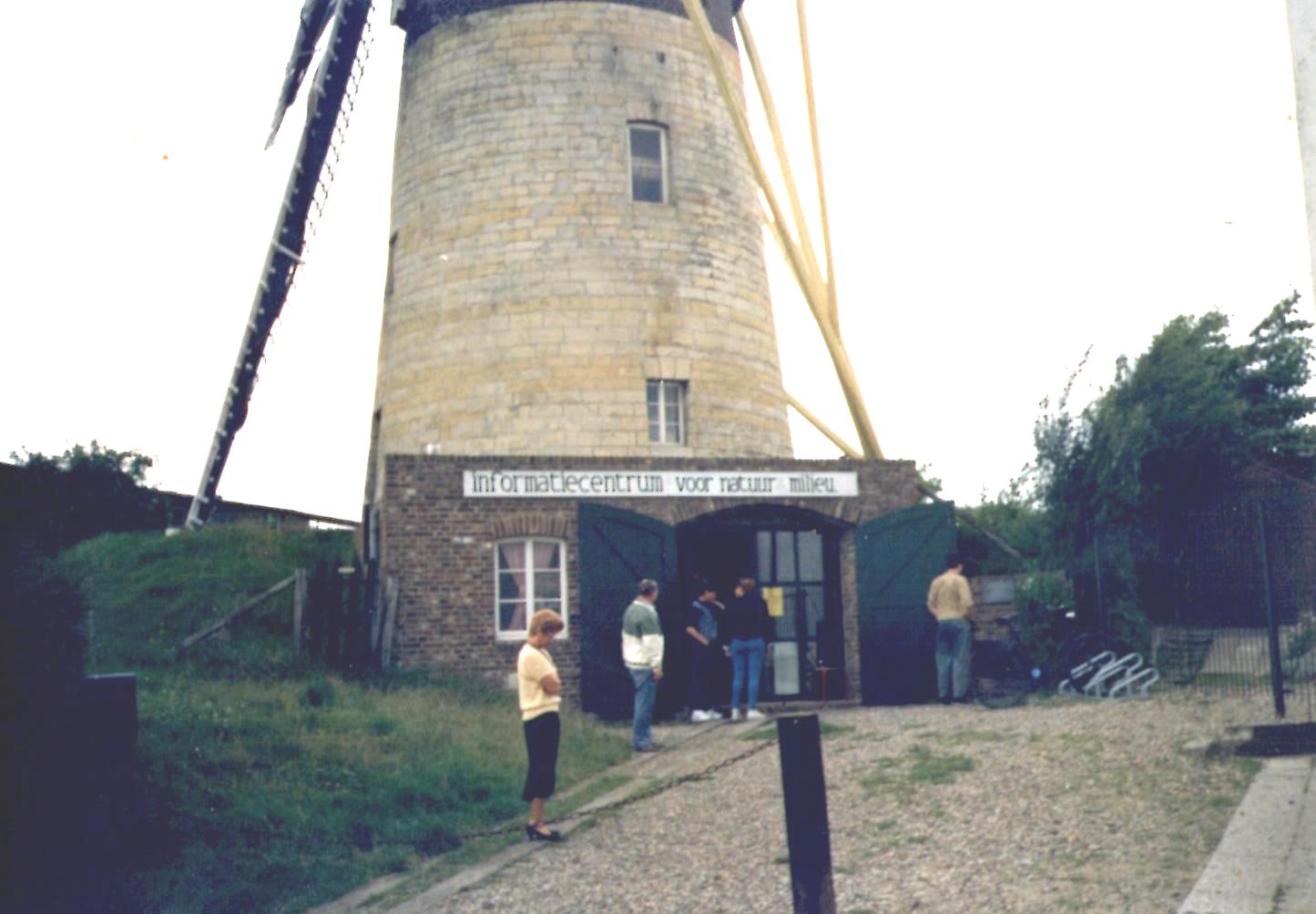
 The Dutch government had nationalized (taken over) all windmills. When my cousins took us to the home I remembered, we saw the windmill was now a museum.  The curator knew my cousins and he was happy to let us tour the two story windmill.  Fond memories for me and a real treat for my son.  How many children can say their mom slept and played in a real Dutch windmill!

My hope is that one day he will take my granddaughter to Bemelen and show her where her grandmother spent her summers.
                              
Hartelijk Dank (thank you so much) Ana Van Lousberg for the color pictures you provided me.  We must be kindred spirits – my (aunt's) family’s last name is Lousberg.